
Calculating the area of a plot of land or a room with four different sides poses a problem that many underestimate. An irregular quadrilateral does not provide its area with just the lengths of its sides. An additional piece of information is needed, and the choice of this information changes everything.
Why four sides are not enough to calculate an area in m²
A rectangle measuring 5 m by 3 m always gives 15 m². Deform it by pushing one corner: the four sides remain the same, but the area changes. An arbitrary quadrilateral with four fixed side lengths can take on an infinite number of shapes, each with a different area.
Without a diagonal or known angle, the area of an irregular quadrilateral is indeterminate. Online calculators that only ask for four sides often overlook this limitation. They assume a cyclic quadrilateral (inscribed in a circle), which almost never corresponds to a real plot of land or a living space.
To eliminate ambiguity, there are two reliable options: measure an interior diagonal (the distance between two opposite corners) or measure an angle with a protractor or a measuring app. The diagonal remains the most accessible solution on-site, as a simple laser meter or a decameter is sufficient.
Knowing how to calculate an area in m² with 4 different sides therefore relies on this preliminary step of additional measurement, without which any result remains approximate.
Triangulation of an irregular quadrilateral: the reference method
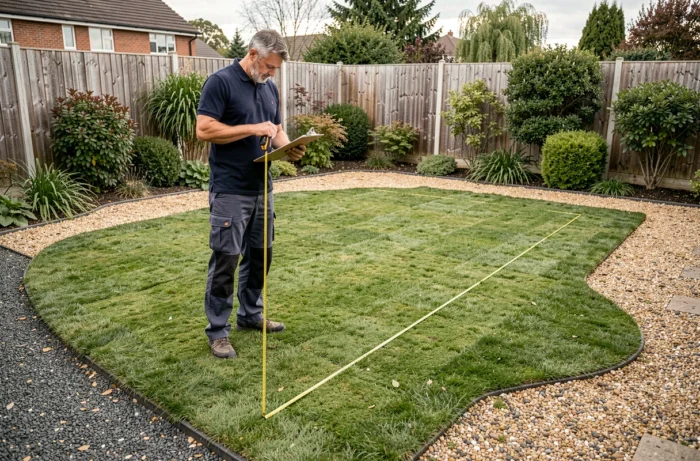
Triangulation involves dividing the quadrilateral into two triangles using a diagonal, then calculating the area of each triangle separately. This is the method most commonly used by surveyors and property inspectors.
Cutting with the right diagonal
A quadrilateral has two diagonals. For a convex quadrilateral (without indentations), both work. For a concave quadrilateral, only the interior diagonal gives a correct result. If you draw the wrong one, part of the area ends up outside the shape, and the calculation is incorrect.
On-site, visually identify if one of the angles “dents” inward. If so, the diagonal connecting the other two vertices is the one to measure.
Applying Heron’s formula to each triangle
Once the diagonal is known, each triangle is defined by three sides. Heron’s formula allows you to calculate the area of a triangle solely from its three lengths, without needing to measure a height.
- Calculate the semi-perimeter of the triangle: s = (a + b + c) / 2, where a, b, and c are the three sides
- Apply the formula: area = square root of s × (s – a) × (s – b) × (s – c)
- Repeat for the second triangle formed by the diagonal and the other two sides
- Add the two areas to obtain the total area of the quadrilateral
This method requires no knowledge of angles. It works for any shape of quadrilateral, provided you have measured a total of five lengths: the four sides and one diagonal.
Bretschneider’s formula: calculating the area with the sides and an angle
Measuring a diagonal is not always possible. On a cluttered or built-up site, drawing a line between two opposite corners can be complicated. Bretschneider’s formula offers an alternative.
This formula calculates the area based on the four sides and the sum of two opposite angles. It generalizes both Heron’s formula (for triangles) and Brahmagupta’s formula (for cyclic quadrilaterals). In practice, you just need to measure two opposite angles of the quadrilateral and then add them together.
The formula is written as: area = square root of (s-a)(s-b)(s-c)(s-d) – abcd × cos²((alpha + gamma) / 2), where s is the semi-perimeter, a, b, c, d are the four sides, and alpha and gamma are two opposite angles.
Calculating by hand can quickly become tedious. However, a simple spreadsheet or scientific calculator provides the result in a matter of seconds. Bretschneider’s formula is more general than triangulation, but it requires measuring angles with sufficient precision, which is less intuitive than measuring a length.
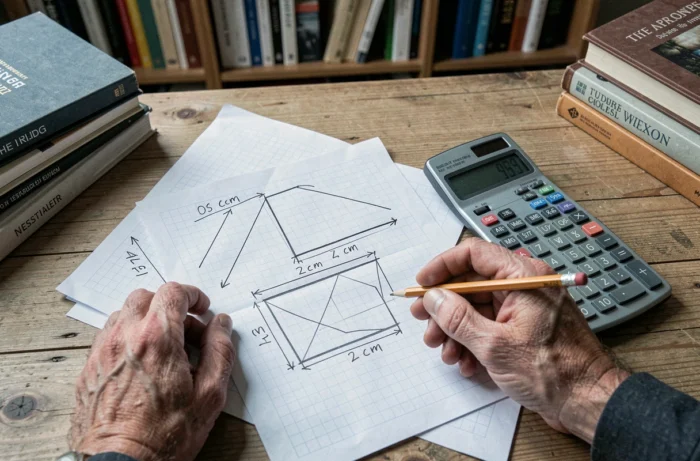
Common mistakes in calculating the area of a quadrilateral with four different sides
Several mistakes consistently occur when individuals measure an irregular area themselves.
Assuming the quadrilateral is a trapezoid is the first source of discrepancy. Applying the formula (large base + small base) / 2 × height assumes that two sides are parallel. In a real plot of land, this parallelism is rarely guaranteed. The resulting error can reach several square meters on a modest-sized plot.
The second trap: confusing perimeter and area. Knowing the sum of the four sides gives no indication of the area. Two quadrilaterals with the same perimeter can have very different areas.
- Not checking whether the quadrilateral is convex or concave before choosing the diagonal
- Rounding side measurements to the nearest whole meter, which cumulatively distorts the final result
- Using an online calculator without checking if it assumes a cyclic quadrilateral by default
In a real estate context, an error of a few square meters directly affects the selling price, especially in areas where the price per square meter is high. For legal measurements (Carrez law, living area), the measurement by a professional remains the only one that carries responsibility in case of discrepancies.
Measuring on-site: tools and precautions for reliable area measurement
A classic decameter is sufficient for the four sides. For the diagonal, a laser rangefinder offers better accuracy, especially beyond ten meters. Some mobile applications use augmented reality to estimate distances, but their margin of error remains higher than that of a laser.
Take each measurement at least twice. The average of two readings reduces the positioning error of the meter. Note the five values (four sides + diagonal) on a scaled sketch before starting the calculation.
For cadastral plots, the cadastral plan provides indicative lengths, not enforceable measurements. A contradictory boundary determination by a surveyor remains the only document that is valid in case of disputes over boundaries, and thus over area.
All the reliability of the result depends on this fifth measurement: diagonal or opposite angle. Without it, four sides do not define a unique area.