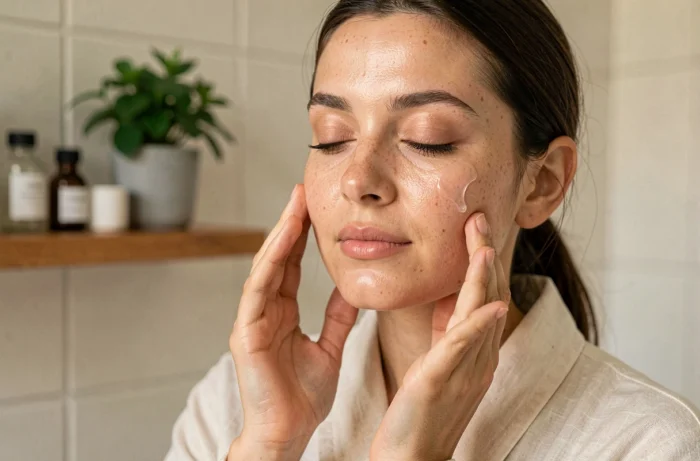
Natural skin radiance depends on a balance between cell renewal, hydration, and protection from external aggressors. Bringing out that glow isn’t about piling on products, but about following precise steps consistently and respecting the skin’s physiology.
Skin barrier and facial radiance: the connection your routine needs to preserve
The outermost layer of the epidermis, the hydrolipid film, plays a direct role in how radiant your complexion looks. When this film is intact, the skin reflects light evenly. When it is disrupted by harsh cleansers or excessive exfoliation, the complexion looks dull.
Choosing a gentle cleanser without sulfate surfactants helps remove impurities without stripping away protective lipids. The goal isn’t to strip the skin, but to maintain a pH close to its naturally slightly acidic level.
Applying a moisturizer while the skin is still damp helps seal water into the epidermis. Formulas containing humectants (glycerin, hyaluronic acid) draw in water, while occlusive agents (shea butter, squalane) limit its evaporation. Moisturizing damp skin enhances the absorption of active ingredients. Several approaches documented on beauteauthentique.fr explain this layered hydration approach, tailored to each skin type.

Daily sun protection: an often-overlooked step to prevent a dull complexion
Sun protection isn’t just for the beach. UV rays accelerate collagen breakdown and stimulate melanin production, leading to an uneven complexion and dark spots.
The American Academy of Dermatology recommends a broad-spectrum sunscreen with an SPF of at least 30 that is water-resistant, applied before going outside and reapplied every two hours outdoors, as well as after swimming or sweating. Most beauty articles mention sun protection without specifying these practical conditions for effectiveness, even though they make all the difference.
A tinted sunscreen containing iron oxide also protects against visible light, which, according to the AAD, may contribute to the appearance of dark spots. For skin prone to pigmentation marks, this type of formula offers a practical twofold benefit.
How to apply sunscreen correctly to your face
Amount matters just as much as frequency. A generous dollop for the face and neck is enough, as long as you don’t forget your ears and the area around your eyes. Apply sunscreen as the last step in your skincare routine, before any makeup.
Cosmetic claims and natural ingredients: separating marketing from real benefits
The word “natural” on a package guarantees neither effectiveness nor better tolerance. In the European Union, Regulation (EU) No 655/2013 governs cosmetic claims: they must be truthful, supported by evidence, and not mislead consumers.
An ingredient of natural origin can be irritating, while a synthetic active ingredient may be perfectly well tolerated. The full ingredient list (INCI) remains the only reliable way to assess a product—far more useful than marketing claims on the front of the bottle.
- Check where the highlighted active ingredient appears in the INCI list: the higher up it is, the greater its concentration in the formula.
- Be wary of very long ingredient lists that bury a few interesting actives in a mostly inert base.
- Choose products whose claims are backed by tests (tolerance, efficacy) mentioned on the packaging or product page.
Learning to read a label takes a little practice, but it’s the most worthwhile step you can take to build an authentic beauty routine based on results rather than promises.

Natural facial beauty routine: the order of steps matters
The order in which you apply skincare directly affects how well it is absorbed. A water-based serum applied after a rich cream won’t penetrate because the oily layer blocks hydrophilic molecules from getting through.
Morning routine to bring out your natural glow
- Cleanse your face with a gentle cleanser (micellar water, sulfate-free gel, or cleansing milk) to remove the sebum that has built up overnight.
- Apply a hydrating serum (hyaluronic acid, niacinamide) to slightly damp skin to improve absorption.
- Apply a moisturizer suited to your skin type in a thin layer to seal in hydration.
- Finish with sunscreen, which is the last skincare step before any makeup.
Evening: cleansing and repair
Double cleansing (an oil-based cleanser followed by a water-based cleanser) is useful for skin that has makeup on it or has been exposed to pollution. For everyone else, one cleanse with a gentle cleanser is enough.
At night, the skin enters an active repair phase. A product containing restorative ingredients (low-concentration retinol, peptides, ceramides) supports this process. Applying it consistently can produce visible results within a few weeks, whereas occasional use won’t make a difference.
Internal factors that affect skin radiance
A topical routine can’t make up for everything. Sleep, internal hydration, and diet directly affect the quality of your complexion. Skin that is dehydrated due to insufficient water intake won’t regain its glow from cream alone.
Foods rich in antioxidants (colorful fruits, green vegetables, nuts and seeds) provide micronutrients that help defend against oxidative stress. Smoking and alcohol, by contrast, accelerate skin aging and measurably dull the complexion.
Chronic stress increases cortisol production, which weakens the skin barrier and can trigger inflammatory flare-ups. Addressing these internal factors often produces more lasting results than adding yet another product to your bathroom cabinet.
Building an effective natural beauty routine comes down to three priorities: preserving the skin barrier, protecting your skin from the sun every day, and choosing skincare based on its actual ingredients. The rest is up to your skin.