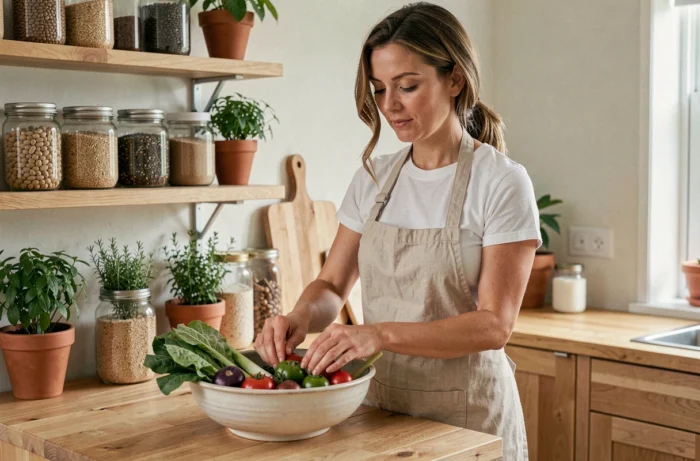
The kitchen utensils and accessories market features product ranges labelled “organic,” “healthy” or “natural,” even though these terms do not correspond to a single standard.
At the same time, European regulations on food-contact materials have tightened in recent years, including a ban on bisphenol A in several categories of materials intended for food contact. Since January 2024, sorting biowaste at source has also been mandatory in France. These two changes have a practical impact on what an organic-focused kitchen should contain.
Food-contact materials: what the “BPA-free” label doesn’t tell you
Most food storage containers and plastic utensils sold today carry a “BPA-free” label. It may be reassuring, but it covers just one of the hundreds of substances found in food-contact materials.
In Europe, any item intended to come into contact with food must meet safety requirements and must not alter the food. For plastics, suppliers must provide a declaration of compliance specifying the conditions of use: the type of food (acidic, fatty or aqueous), the maximum temperature and the contact time. This document is the real basis for comparing two products—far more useful than the “BPA-free” logo on the packaging.
When choosing your equipment from Le Bio du Coin, you can weigh these regulatory criteria alongside product ranges designed for everyday use in an organic kitchen. The key is the same: check the declared compliance rather than relying on marketing alone.
The same approach applies to non-stick coatings on frying pans and saucepans. PTFE-based coatings (Teflon) have not been shown to pose a problem at normal cooking temperatures, but their limited lifespan means they need to be replaced frequently. Stainless steel, cast iron and unglazed ceramic offer significantly greater durability over several years, reducing both waste and long-term costs.
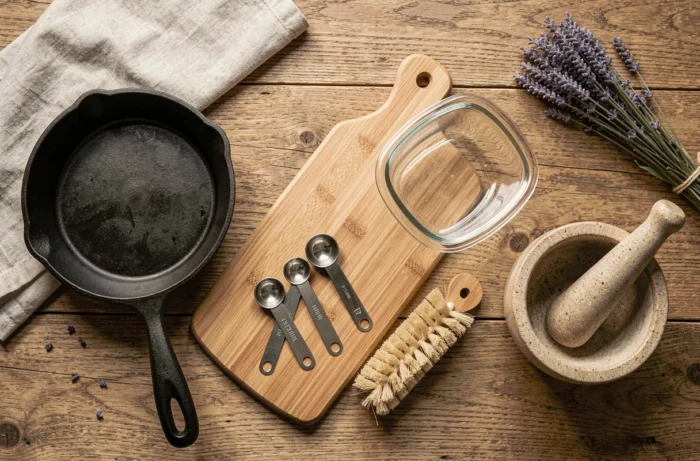
Sorting biowaste in an organic kitchen: adapt your worktop
Since 1 January 2024, all French households have been required to sort their biowaste at source. Depending on the local authority, this may mean using an individual compost bin, a dedicated kitchen caddy or a communal drop-off point.
In an organic kitchen, where vegetable peelings and scraps are plentiful, this changes how you organise your food prep area. A compact sorting caddy placed right next to the chopping area saves trips back and forth and reduces the risk of cross-contamination with other waste.
What to look for in an indoor food waste caddy
- An airtight lid to contain odours, especially in summer or in kitchens without direct ventilation
- A capacity suited to how often you empty it: small models (3 to 5 litres) work well if you empty them every other day, while medium-sized ones (7 to 10 litres) suit weekly emptying
- A material that can be cleaned in a washing machine or dishwasher, making regular cleaning practical rather than merely theoretical
Adding a sorting station to your worktop may mean reorganising the space under the sink or installing a wall-mounted holder. It’s a small adjustment that makes a lasting difference to the workflow in your kitchen.
Repair rather than replace: an overlooked factor when buying kitchen equipment
The lifespan of a food processor, blender or small kitchen appliance depends as much on how easy it is to repair as on its original quality. Since France’s anti-waste law came into force, a repairability index has been displayed on certain categories of appliances.
In an organic kitchen, where people often prepare food from scratch (soups, purées, pastry dough and plant-based milks), appliances get more use than average. Choosing a model with replaceable blades, seals and motors can extend its useful life by several years.
Brands that publish disassembly manuals and keep spare parts in stock over the long term stand out. Checking this before you buy can prevent you from throwing away a working appliance because a worn part is no longer available.
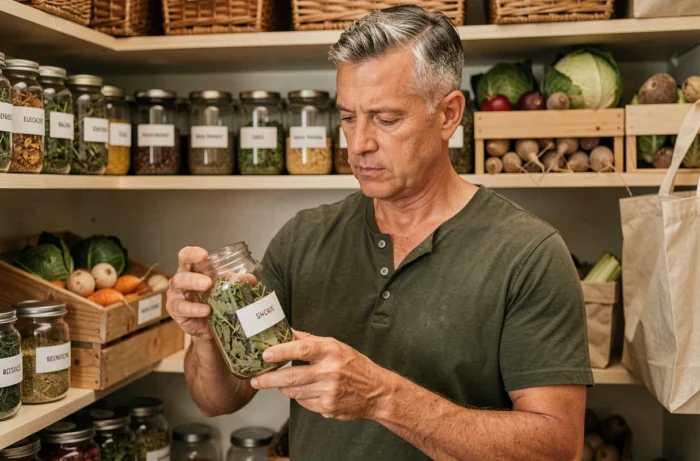
Organic food-prep utensils: prioritise based on how you actually cook
Specialist shops offer dozens of utensils made from wood, bamboo or food-grade silicone. Buying them all at once is expensive and clutters your drawers. It’s better to start with the recipes you make regularly.
- For raw vegetables and salads, a mandoline with a hand guard and a good chef’s knife cover most chopping needs
- For steaming, a stainless-steel basket that fits an existing saucepan is a practical alternative to a dedicated steamer
- For food storage, glass jars with mechanical seals (such as Le Parfait jars) remain the most versatile and durable option compared with plastic containers
A common pitfall is accumulating single-use gadgets (avocado slicers, novelty garlic presses, specialist peelers). Each extra item takes up space and needs cleaning. Three well-chosen, versatile utensils can replace ten specialist accessories.
Organise by work zone
Grouping utensils by function (preparation, cooking and storage) rather than by material makes everyday tasks easier. Keep cutting tools near the worktop, spatulas and whisks near the hob, and jars and wraps near the fridge.
Organising by zone cuts down on unnecessary movement while preparing meals. It also makes cleaning easier, since each area has its own storage routine.
Choosing equipment for an organic kitchen is about more than ticking “natural” or “eco-friendly” on a product listing. Regulatory compliance for materials, appliance repairability and the ability to sort biowaste have a greater long-term impact than a label on the packaging. Start with the recipes you make, check declarations of compliance and prioritise versatility over quantity—it’s the most reliable way to choose.