The arrival of a baby generates on average several hundred kilos of waste in the first years, including diapers, packaging, and quickly outgrown new equipment. Welcoming a child in a healthy, ethical, and responsible way requires making concrete choices about materials, food, and everyday items. Since 2026, new European regulations are changing the usual benchmarks regarding the safety of baby products, including for parents who cook at home.
Food Contaminants for Babies: What the 2026 European Regulations Change
Cooking at home does not protect against all contaminants. Recent European texts target process contaminants that also form in a domestic kitchen.
The Regulation (EU) 2026/1825, applicable since August 19, 2026, lowers the maximum levels of 3-MCPD and glycidyl fatty acid esters in oils and fats intended for infant preparations. A further reduction is planned for January 1, 2027, for certain infant milk formulas.
The Regulation (EU) 2026/1890, which will come into force after January 1, 2028, sets thresholds for furan and methylfurans in cereals and baby food for the first time. These substances form during high-temperature cooking, including in purees and compotes prepared at home.
In practice, this means that choosing organic or local is not enough. The cooking method is as important as the origin of the ingredients: parents who reference their food choices on the site bebe-ethique.fr will find guidelines on supply chains, but vigilance regarding preparation temperatures remains a reflex to adopt.
Endocrine Disruptors in Baby Care Products and Toys
The European Union is preparing restrictions on endocrine disruptors in cosmetics, with a phased implementation planned starting in 2026. For parents, the issue goes beyond creams and lotions: it also concerns toys, textiles, and food containers.
The new European regulation on toy safety, which will replace the 2009 directive, introduces specific limits for endocrine disruptors in toys intended for children under 36 months. Manufacturers will need to document the chemical compliance of their products more rigorously.
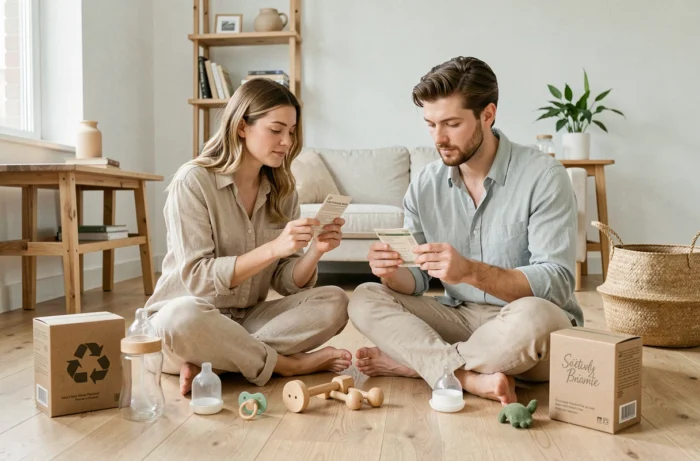
Field reports vary on this point: some organic or natural labels already exclude these substances, while others limit themselves to current regulatory obligations. Reading the composition is not always sufficient, as endocrine disruptors are not systematically listed on the labels of toys or textiles.
Concrete Criteria for Sorting Products
- Check for the presence of a certified textile label (GOTS, Oeko-Tex Standard 100 class 1) that tests for residual chemical substances on fabrics in contact with the baby’s skin
- For wooden toys, ensure that the paints and varnishes comply with the EN 71 standard, and prefer untreated raw wood when possible
- For care products, avoid formulations containing synthetic fragrances, even if the packaging states “natural” or “gentle”
Second-Hand Clothing and Equipment: The Trade-Off Between Budget and Safety
Buying second-hand is the most direct action to reduce the ecological footprint of a newborn. Second-hand clothing has the advantage of having been washed many times, which reduces the residual concentration of chemical substances in the fibers.
For childcare equipment, the logic is different. A second-hand crib, car seat, or baby carrier may have invisible defects (weakened structure, worn harness, compressed foam). Safety standards evolve regularly, and equipment that was compliant five years ago may not be today.
The AGEC law (Anti-waste for a Circular Economy) has expanded the recovery and refurbishment channels for childcare items. Some retailers now offer refurbished equipment with a warranty, providing a compromise between price, ecology, and verified safety.
Points of Caution Regarding Second-Hand
- Never buy a second-hand baby mattress: deformation and the accumulation of dust mites pose a real health risk
- For car seats, check the manufacturing date and the absence of product recalls before purchasing from individuals
- Second-hand organic cotton clothing has two advantages: fibers already free from chemical residues and a reduced carbon footprint
Baby’s Room and Indoor Air Quality: Beyond Ventilation
Daily ventilation of the room is advice repeated everywhere. The point not to overlook is the renovation schedule. New furniture, paints, and flooring emit volatile organic compounds for several weeks after installation.
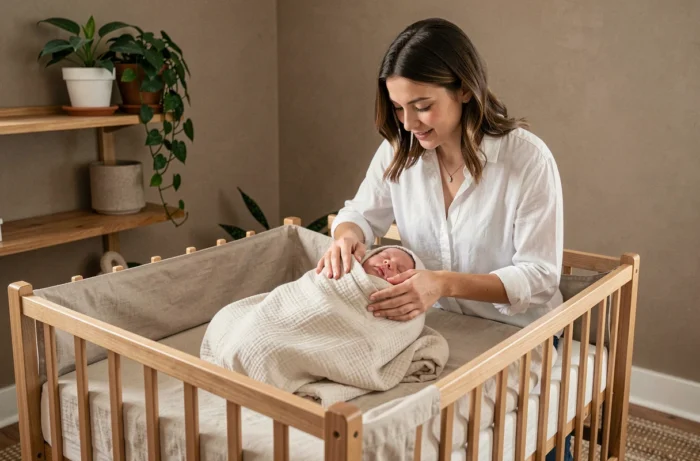
Setting up the room at least two months before the baby’s arrival, with windows open as often as possible during this period, significantly reduces initial exposure. Choosing solid, unvarnished wood furniture, or a bed with finishes based on natural oil or wax, limits emissions at the source.
The available data do not allow for a conclusion on an absolute safety threshold for VOCs in an infant’s room. However, combining controlled mechanical ventilation with low-emission materials remains the most documented strategy for maintaining acceptable air quality.
Choosing to welcome a baby responsibly is not just a matter of an ethical shopping list. It involves a series of decisions about materials, cooking methods, standards to check, and compromises to accept between budget, practicality, and health requirements. Recent European regulations set new benchmarks, but each household must still adapt them to its preparation habits, housing, and budget.