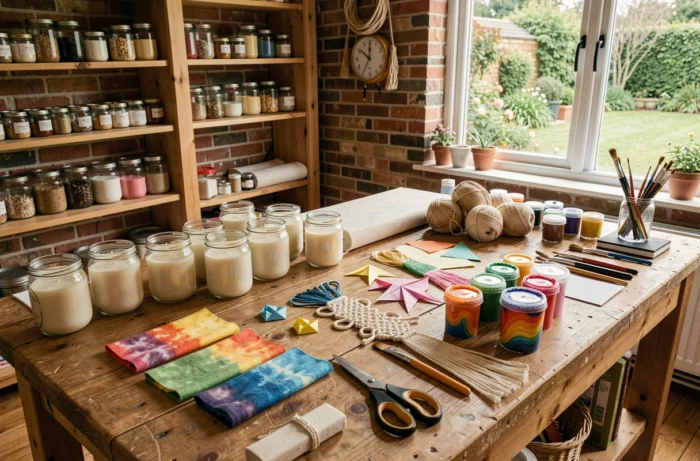
Creative DIY at home is no longer just about occupying a rainy afternoon. Recent data positions these hands-on activities as a lever for well-being, with documented effects on relaxation and stress management in adults. For children, the European regulatory framework has tightened since 2025 regarding the safety of materials used in creative kits.
Here are ten concrete activities, accessible with common materials, that allow for fun without leaving home.
1. Making candles in recycled glass jars

Recycling glass jars to pour wax is both a simple and rewarding activity. All you need is soy or paraffin wax, a cotton wick, and a heat-resistant container. The process takes less than an hour, including drying time.
A point of caution: recent recommendations emphasize the need to check the toxicity of colorants and fragrances added to the wax. Prioritizing natural essential oils and working in a ventilated space remains the basic rule, especially if children are involved.
If you’re looking for creative DIY activity ideas to do at home, candle making is among the most accessible projects for beginners.
2. Natural dye workshop on fabric
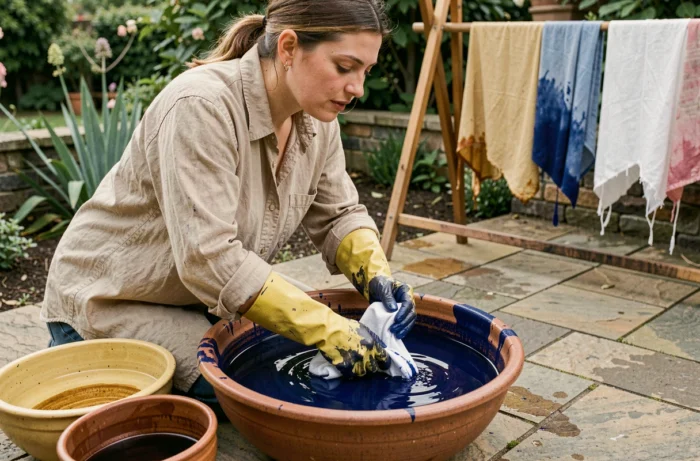
Dyeing fabric with kitchen ingredients (turmeric, beetroot, red cabbage, onion peels) transforms a simple square of cotton into a unique piece. This ancient technique requires no specialized equipment: a pot, white vinegar as a fixative, and fabric made from natural fibers are sufficient.
The result varies depending on the immersion time and the concentration of the dye bath. The shades obtained remain soft, far from the saturated colors of chemical dyes. It is precisely this imperfect rendering that makes the exercise interesting.
3. Building photo frames from cardboard and decorative paper
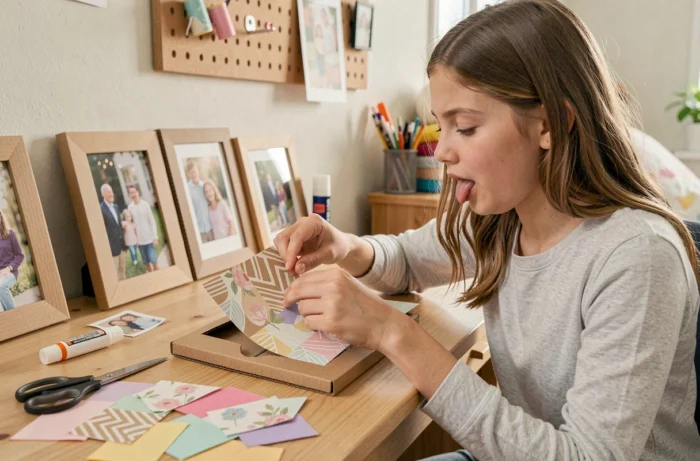
A piece of thick cardboard, washi paper or adhesive fabric, and a pair of scissors: the DIY photo frame remains one of the quickest creative crafts to make. By cutting two rectangles of cardboard (one solid, the other hollowed out in the center), you get a structure ready to decorate in just a few minutes.
This project is particularly suitable for children aged four or five, provided that the use of scissors is supervised. Finishing touches (glitter, stamps, collages) allow for personalizing each frame according to individual tastes.
4. Creating cold process handmade soaps
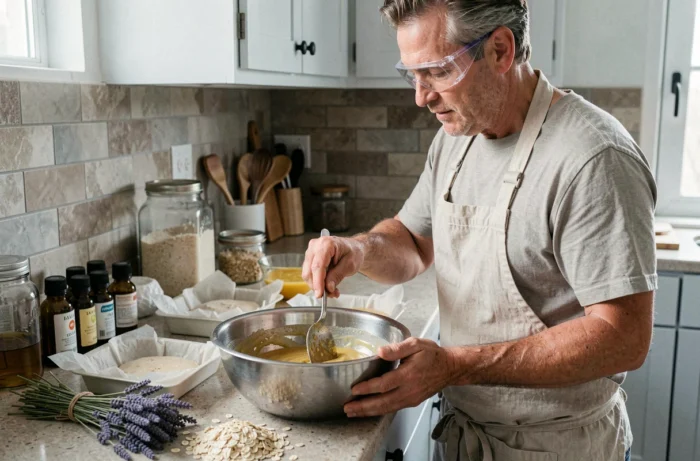
Cold saponification requires a bit of rigor, but the result is durable and useful in daily life. Melt and pour soap bases simplify the process for those who want to avoid handling caustic soda.
Again, the issue of chemical substances arises. Recent sources recommend prioritizing the origin of materials and checking the composition of bases, particularly preservatives and synthetic fragrances. A well-formulated homemade soap remains more transparent than an industrial product in this regard.
5. Japanese binding for homemade notebooks
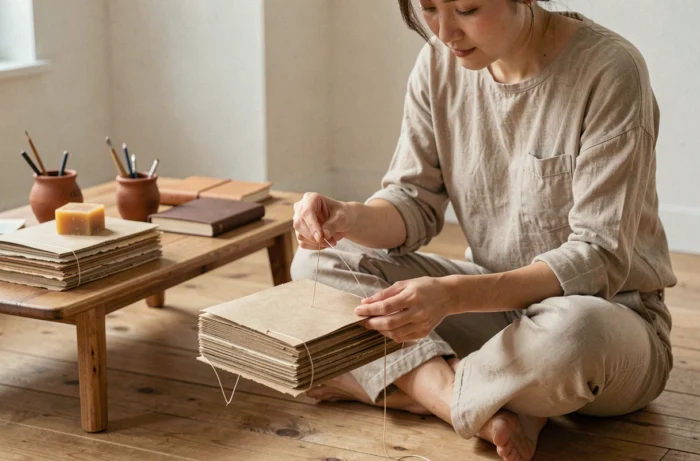
Japanese binding (stab binding) uses a needle, thread, and a few folded sheets to assemble a notebook without glue. This technique produces neat objects with minimal materials. Three or four holes punched in the spine are sufficient for basic models.
The format is suitable for both a diary and a sketchbook or photo album. Covers made from kraft paper, fabric, or wallpaper scraps give a handmade look that is difficult to replicate with a commercial product.
6. Mosaic with leftover tiles or broken dishes
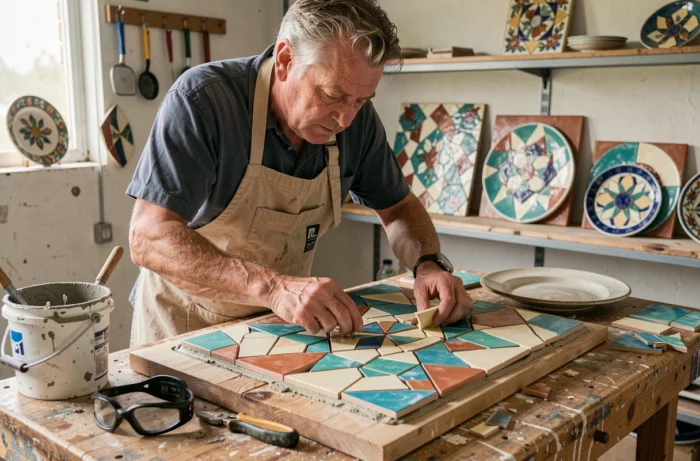
Recovering shards of dishes or leftover tiles to create a mosaic on a tray, flower pot, or trivet is both a decorative and anti-waste activity. Tile adhesive and a standard grout complete the work.
Handling sharp pieces requires wearing gloves, especially for beginner DIYers. Ventilating the room during grout application is part of the basic precautions, as recent recommendations on solvent and adhesive safety directly apply to this type of project.
7. Modular origami for wall decor
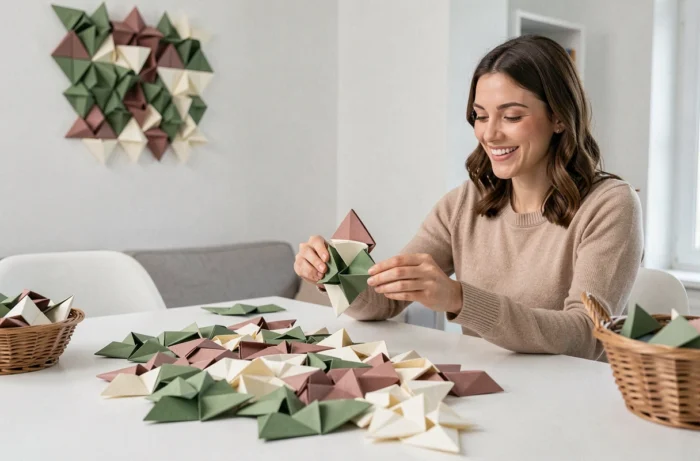
Modular origami involves folding several identical modules and then fitting them together without glue to form a three-dimensional structure. Stars, cubes, and polyhedra are the most common models. The only material required is square paper, available in reams at most stationery stores.
This activity develops patience and precision. It works well both solo and in a group workshop, with each participant folding their modules before the final assembly.
8. Making stamps from carving rubber
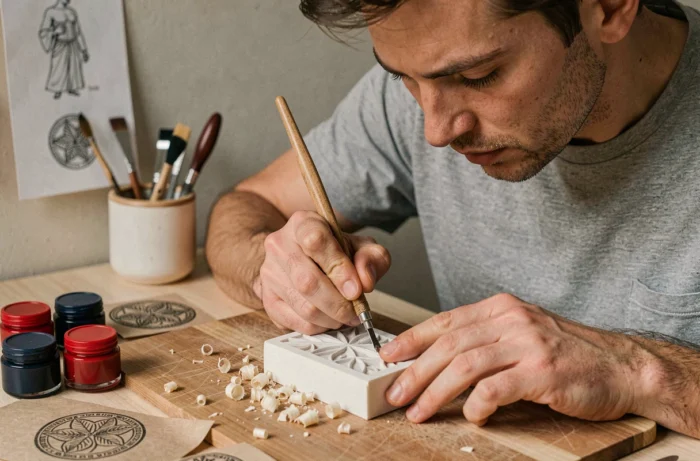
Carving a design into a block of special rubber (such as Speedball or Factis) with a small gouge allows for creating reusable custom stamps. The design is first drawn with a pencil on the rubber, then carved out. The ink applied to the remaining raised areas produces the imprint.
The basic materials (rubber, handle gouge, stamp ink) are affordable and can be found at craft stores. A well-carved stamp lasts for years to personalize mail, gift wrap, or notebooks.
9. Wall macramé with cotton cord
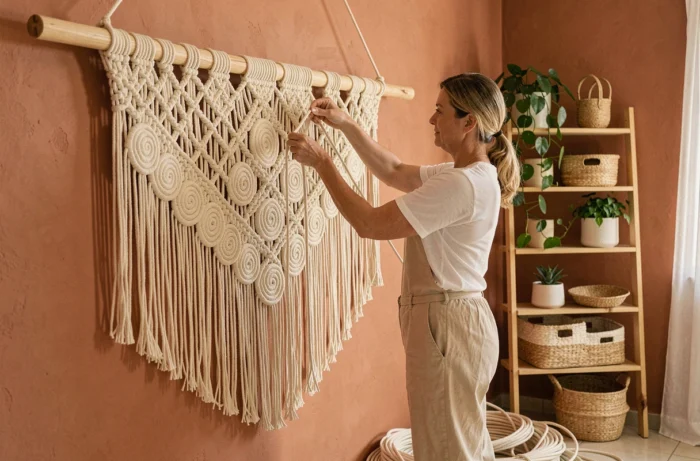
Macramé is based on a limited number of knots (square knot, half-hitch, spiral knot) combined to form geometric patterns. A wooden stick or branch as a support, and cotton cord with a diameter of three to five millimeters: the materials fit in a bag.
Field feedback varies on the actual difficulty of macramé for beginners. Online tutorials simplify learning, but maintaining consistent tension requires practice. A first modest-sized project (a plant hanger, for example) allows mastering the techniques before moving on to a more ambitious wall piece.
10. Acrylic pouring art
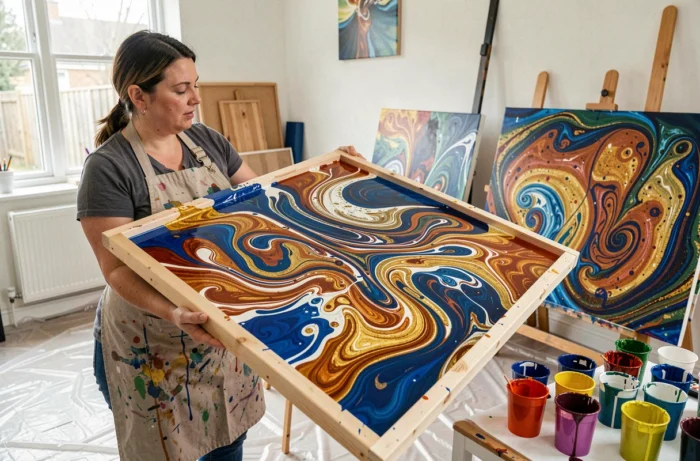
Acrylic pouring art involves mixing acrylic paint with a pouring medium, then pouring the colors onto a canvas and letting them mix by gravity. The result, always unique, requires no drawing skills.
This technique generates splashes: protecting the work surface with a tarp is a non-negotiable prerequisite. Creative DIY is repositioning itself as a wellness practice, and pouring art illustrates this trend well, as the act of pouring and observing the colors interact has a documented meditative effect from several recent sources.
Each of these ten activities relies on common or easily obtainable materials. The only common point to watch for, regardless of the chosen project: the quality and safety of the products used, especially adhesives, paints, and solvents, which European regulations now more strictly govern in terms of composition and labeling.