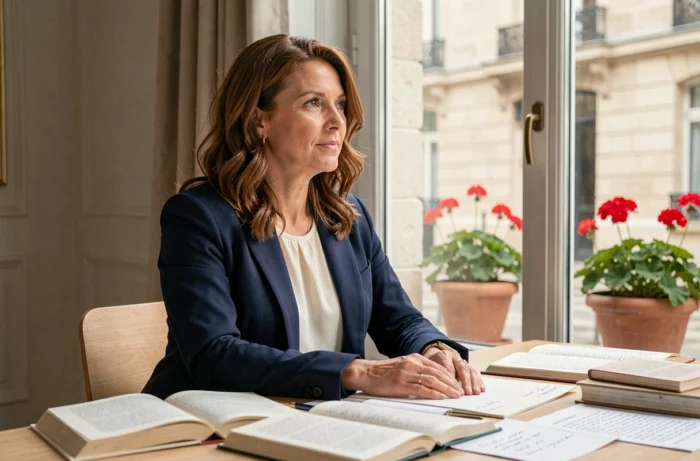
Juliette Plumecocq-Mech was born on January 1, 1968, in Soissons. A French actress with an atypical career, she has built her career between theater and cinema over more than three decades. Her private life, however, remains a territory that neither interviews nor social media document.
This lack of public information about her partner or husband has not prevented search engines from producing dozens of results promising revelations. The phenomenon deserves as much attention as her artistic journey itself.
When Google Creates a “Husband” for Juliette Plumecocq-Mech
Type “Juliette Plumecocq-Mech husband” into a search engine: you will get a series of pages with catchy titles. “What we know about her husband today,” “our investigation into the man who matters in her life,” “social media fuels speculation.” Each of these articles promises an answer. No verifiable public source confirms the existence of an identified spouse.
The mechanism is well-known in SEO. A popular query (a celebrity’s name + “husband” or “couple”) generates traffic. Editorial sites then create content around this query, even when the factual answer is: we don’t know. The reader clicks, browses an article that revolves around the topic, and leaves without new information.
Several recent pieces mention director Christophe Rauck as a potential partner. Upon carefully reading the biography of Juliette Plumecocq-Mech and her husband, it becomes clear that this lead is based on a confusion between long-standing artistic collaboration and romantic relationship. Rauck is documented as a director and work partner, not as a spouse.
From Théâtre du Soleil to Cinema: A Journey Rooted in Theater
Before appearing on screens, Juliette Plumecocq-Mech trained at the Conservatoire à rayonnement régional de Bordeaux. She then joined the Théâtre du Soleil troupe, led by Ariane Mnouchkine. It was there that she met Christophe Rauck.
In 1995, Rauck created the Compagnie Terrain Vague-(provisional title) with Juliette and other actors from the Théâtre du Soleil. This company became the framework for a lasting collaboration. Juliette plays Brecht, Shakespeare, Simovic there. Her androgynous physique opens up male roles for her: Lancelot in Le Dragon, Khlestakov in Le Révizor, Aristarque in Cœur ardent.
In 2016, Rauck directed her in Toute ma vie, j’ai fait des choses que je savais pas faire, a text by Rémi De Vos where she portrays, lying down, a man assaulted in a café. This play illustrates the nature of their bond well: an artistic trust built over two decades on stage.
Filmography and Recognition in Cinema
In cinema, her presence gradually asserts itself. Among her notable films are Radiostars, Antoinette in the Cévennes, and Coup de chance, Woody Allen’s latest feature film shot in France. On television, she has roles in Le Tueur du lac, Transferts, and more recently the series À l’instinct on France 2.
The actress has also collaborated with other theater directors:
- Julie Brochen in Whistling Psyche by Sebastian Barry, a very intimate register far removed from the Théâtre du Soleil
- Christian Schiaretti in Perceval le Gallois by Florence Delay, a production at the Théâtre National Populaire
- Olivier Martin-Salvan in Ubu sur la butte by Alfred Jarry, where she returns to a burlesque register
In 1993, she received the Prix de la Critique from the Association québécoise des critiques de théâtre. This award, obtained early in her career, reflects recognition by her peers even before her appearance in front of the camera.
The Androgyny of Juliette Plumecocq-Mech: Wound Turned Tool
An interview with Télé Star sheds light on an aspect rarely addressed in standard biographical summaries. Juliette Plumecocq-Mech has long lived with the wound of being mistaken for a man. This confusion, linked to her androgynous physique, eventually became a strength in her performances.
In theater, this physical ambiguity has allowed her to access a repertoire of unusual male roles for an actress. Christophe Rauck has been able to exploit this uniqueness by entrusting her with characters like Khlestakov or Lancelot. The transition from wound to professional tool was not immediate.
This dimension also explains why the question of her private life generates so much curiosity online. Androgyny blurs the public’s references, and search engines capture this curiosity in the form of queries about her couple or orientation.
Private Life of French Actresses: What the Query “Husband” Reveals
The case of Juliette Plumecocq-Mech is not isolated. The query “name + husband” is systematically generated by search engines for any female personality who reaches a certain level of visibility. The phenomenon affects actresses much more than actors.
What distinguishes this case is the total absence of factual material to exploit. No couple photo, no mention in interviews, no post on social media. The articles that position themselves on this query acknowledge this themselves, sometimes right from their introduction, before filling the rest of the page with information about her career.
This mechanism raises an editorial question. Should content be produced to respond to a search demand when the honest answer can be summed up in one sentence? The available data does not allow for a conclusion about her marital situation, and it is precisely this limitation that should constitute the answer.
Juliette Plumecocq-Mech continues to act. The series À l’instinct on France 2 offers her a recurring role that expands her audience. Her career, patiently built between Bordeaux, the Théâtre du Soleil, and film sets, speaks more than any speculation about her romantic life. The artistic journey remains the only documented and verifiable territory.