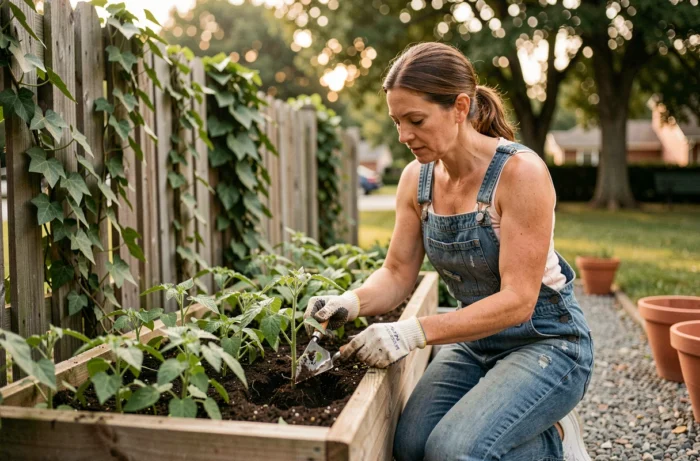
A productive garden year-round relies less on the accumulation of seasonal actions and more on structural choices made in advance. Living soil, updated regulatory framework, adaptation to extreme weather events: these three pillars determine success well before the question of planting schedules arises.
Living soil and fertility: the often underestimated technical basis
The majority of garden failures stem from impoverished or compacted soil, not from poor varietal choices. Before any planting, we recommend assessing the soil structure: clayey, loamy, or sandy texture, water retention capacity, organic matter content.
A regular supply of mature compost restores the microbial life of the soil in just a few seasons. Compost acts both as a structural amendment and as a slow-release nutrient reservoir, which reduces dependence on fertilizers.
We observe that a significant portion of French gardeners now systematically enrich the soil with compost and use ground cover plants to limit evaporation. These practices are not cosmetic: they permanently alter the water behavior of the substrate. When looking to deepen these techniques, discovering the Conseil Jardinage website allows for cross-referencing concrete feedback on different types of soils and climates.
Permanent mulching (dead leaves, wood chips, straw) complements this approach. A mulch several centimeters thick reduces evaporation and nourishes the soil fauna, with earthworms at the forefront. In winter, it protects roots from frost. In summer, it buffers heat spikes at the root level.
Labbé Law and weeding: the regulatory framework that gardeners ignore
Since January 1, 2019, the Labbé law prohibits individuals from purchasing, possessing, and using synthetic phytosanitary products in their gardens, yards, vegetable patches, and pathways. Glyphosate is included, but not only: this ban covers all synthetic products, without distinction between occasional and regular use.
One point remains unknown: using a bottle purchased before 2019 constitutes a legal offense. Old stocks are not exempt from the rule. Only biocontrol products and base substances labeled “Authorized for use in the garden” (EAJ) remain accessible to amateurs.
This evolution makes part of the artisanal weeding practices, sometimes presented as “natural,” illegal. Concentrated white vinegar used as a herbicide, for example, raises questions when sold or used with a phytosanitary claim. We recommend limiting to mechanical solutions and mulching for weeding:
- Manual weeding or with a hoe, targeting weeds before they go to seed to limit the soil seed bank
- Thick organic mulching (straw, leaves, wood chips) that deprives unwanted plants of light while nourishing the soil
- Ground cover plants (white clover, phacelia, buckwheat) that occupy space and prevent weed germination through direct competition
Resilient garden against heatwaves: adapting practices to the current climate
The notion of a resilient garden has emerged in recent years as a structuring framework, distinct from mere seasonal adjustments. The goal: to design a garden capable of withstanding heatwaves, prolonged droughts, and episodes of heavy rain without constant intervention.
In practical terms, this begins with the choice of plants. Mediterranean plants (lavender, rosemary, santolina) and deep-rooted perennials withstand summer water restrictions better than thirsty annuals. For the vegetable garden, shifting sowing to autumn rather than spring helps avoid exposing young plants to heat spikes.
Shade becomes a fully-fledged technical lever. Deciduous trees, green pergolas, or shade sails protect crops sensitive to the hottest hours. In Chambord, repeated heatwave episodes now force horticultural teams to rethink the very structure of gardens to integrate more shaded areas.
Water management during restriction periods
Drip irrigation, positioned under the mulch, limits losses through evaporation. We recommend watering exclusively in the evening or early morning, when soil temperatures have dropped.
Rainwater harvesting complements the system. A collector positioned at the gutter outlet provides a valuable reserve for restriction periods. In case of prolonged drought, prioritize watering the vegetable garden and young plantings rather than the lawn, which naturally goes dormant and greens up with the first rains.
Sowing calendar and rotations: plan rather than react
A productive garden all year round relies on an anticipated cultivation plan. Crop rotation over three or four years limits soil depletion and breaks pest cycles. Alternating legumes (which fix nitrogen), leafy vegetables, and fruiting vegetables on the same plot maintains fertility without massive external input.
- Autumn: sowing green manures (mustard, phacelia, rye) on freed plots, which protect bare soil and will be incorporated in spring
- Winter: preparing cultivation plans, ordering seeds, checking the condition of pruning and trimming tools
- Spring: sowing tender vegetables (tomatoes, peppers, eggplants) under cover, then transplanting after the last frosts
- Summer: harvesting, monitoring watering, sowing autumn vegetables (lamb’s lettuce, spinach, winter radishes) from mid-August
Pruning spring-flowering shrubs just after their flowering and summer-flowering shrubs at the end of winter remains a basic rule, but it avoids yearly timing errors that compromise flower and fruit production.
Month-by-month planning is not enough if the soil is dead and the regulatory framework is ignored. A garden that endures the seasons without weakening is primarily a garden whose structure, soil, and plant choices have been designed to absorb uncertainties, not to suffer from them.